Methods · Gurugram
Dust-Free Concrete Cutting: How Wet Cutting Works Indoors
Wet diamond cutting controls silica dust at the blade edge, making it the practical way to cut concrete inside occupied homes and offices.
- Fijer Ali
- 14 January 2026
- Updated 2 February 2026
- 6 min read
Dust free concrete cutting is not a marketing phrase, it is a specific technique: feeding water directly onto the diamond blade or core bit while it cuts, so the fine concrete and silica particles bind to water droplets instead of becoming airborne. Done properly, a wet cut inside an occupied flat in Sector 56 or a running office on Golf Course Road leaves almost no visible dust and far less respirable silica in the air than any dry method.
The short answer for anyone asking how to cut concrete indoors without a dust storm: use a wet diamond saw or core drill with a water swivel, contain the slurry with a vacuum or catch tray, and ventilate the room. Dry cutting with an angle grinder or a dry-rated blade should be avoided indoors except for very short, small cuts with a HEPA-shrouded vacuum attached, because dry cutting throws crystalline silica dust that settles on furniture and lungs alike.
This piece explains the mechanics of wet cutting, why it matters for health, how we protect flooring and fittings while doing it, and what it typically costs compared with dry methods described in our wet vs dry cutting comparison.
Why water controls dust at the source
A diamond blade does not cut concrete by shearing it like a knife, it grinds a kerf using thousands of exposed diamond grits bonded into a metal segment. That grinding action generates heat and pulverises the aggregate and cement paste into extremely fine particles, a large share of which is crystalline silica small enough to lodge deep in lung tissue. Water introduced right at the point of contact wets these particles the instant they are created, turning them into a heavier slurry that falls rather than floats. This is why the water needs to reach the blade edge, not just splash nearby; a trickle aimed a few centimetres away from the cut does very little.
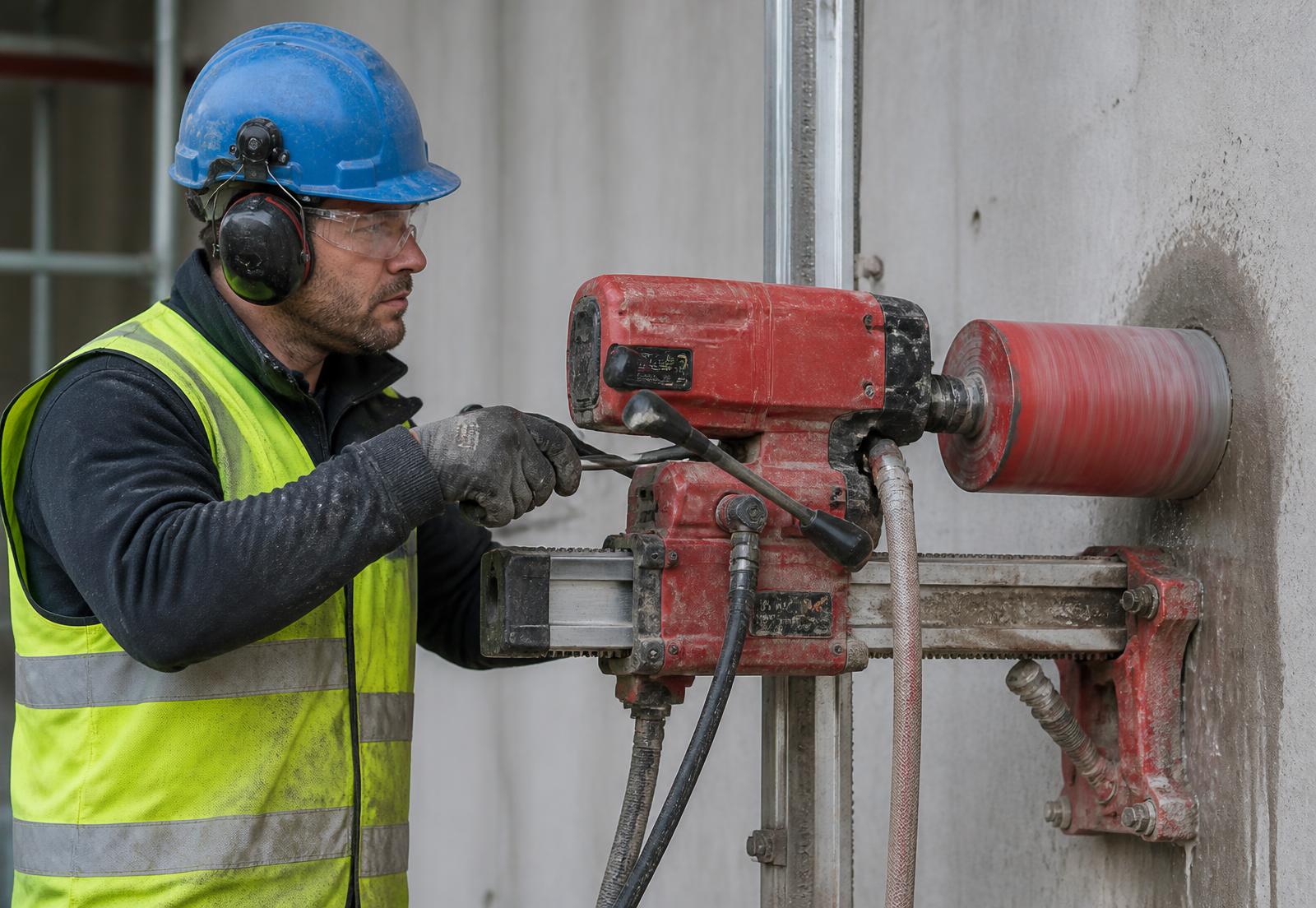
Core drills use the same principle through a water swivel that feeds water down the centre of the hollow bit, flushing the slurry up and out of the hole as it cuts. Wall saws and floor saws for larger openings, described in our slab cutting guide, use a similar water-fed carriage.
The health case for wet cutting
Respirable crystalline silica from dry-cut concrete is classified as a lung carcinogen and is linked to silicosis, a permanent scarring of lung tissue that has no cure. This is not a theoretical risk for construction workers only; anyone in the room during a dry cut, including residents, office staff or shopkeepers, is exposed. The Central Pollution Control Board and international bodies both treat silica dust as a serious occupational and public health hazard, and Indian workplace safety norms increasingly reference exposure limits similar to those used globally.
The first time a client sees a wet-cut AC hole finish clean with zero dust on the sofa six feet away, they stop asking why we insist on water lines even for a single core.
How we run a dust free job indoors
- Lay containment sheeting on floors and furniture within a two to three metre radius of the cut line.
- Connect a water tank or tap line with a pressure-fed hose to the saw or drill's water inlet before starting.
- Use a wet vacuum or a bunded catch tray to collect slurry as it is produced, not after the cut is finished.
- Tape off skirting, switch boards and any exposed wiring that water should not reach.
- Ventilate the room with a window or exhaust fan running, even though airborne dust is minimal, to clear any residual mist.
For openings near electrical points, such as an AC hole close to a switch board, we adjust the water flow and use extra sheeting rather than skip the water altogether, because a dry cut there still creates a dust hazard disproportionate to the small convenience gained.
What wet cutting means for your interiors
Clients worry, reasonably, that water on site means water on their marble or wooden flooring. In practice the slurry is collected almost as fast as it forms when the crew works with a helper managing the vacuum, and any residual moisture is wiped down before we leave. We ask that valuable furniture and electronics be moved out of the immediate work area regardless of method, since vibration and general site activity carry their own risks.
Rooms where wet cutting needs extra care
Kitchens with wooden cabinetry, rooms with false ceilings hiding wiring, and spaces with existing water seepage issues need a slightly different approach: shorter water bursts, more frequent vacuum passes, and sometimes a sacrificial ply sheet under the cutting zone. In older buildings around DLF Phases where floor traps may already be blocked, we check drainage before starting so slurry water has somewhere safe to go.
Indicative pricing
| Job type | Typical range (INR) | Notes |
|---|---|---|
| Single wet core hole (75-150mm) | ₹800 - ₹1,800 | Confirm on quote, depends on wall thickness |
| Wet-cut slab opening (up to 2 sq ft) | ₹2,500 - ₹5,000 | Includes containment and slurry cleanup |
| Dry cut with HEPA vacuum (small, exterior) | ₹600 - ₹1,200 | Only recommended outdoors or in unfinished spaces |
See our full cost and price guide for how wall thickness, access and reinforcement affect the final number.
When dry cutting is still acceptable
Dry cutting has a place: quick control joints in a construction site with no occupants nearby, or exterior cuts where dust disperses in open air away from people, roads or drains. Even then a shroud connected to an industrial vacuum with a HEPA filter reduces exposure meaningfully. Indoors and in occupied buildings, wet cutting or dust extraction is not optional from a professional standpoint, only the degree of containment changes.
- 1Confirm access to a water source or bring a tank if the site has none.
- 2Walk the site to identify furniture, electronics and finishes that need covering.
- 3Mark the exact cut line and check for hidden services with a scanner.
- 4Set up containment sheeting and the water/vacuum system before the blade touches concrete.
- 5Cut in controlled passes, clearing slurry continuously rather than in one long push.
- 6Clean, dry and inspect the area, then hand over with a short walkthrough.
Booking a dust free cut in Gurugram
If you have a cutting job planned inside a finished home, clinic or office anywhere from Sohna Road to Manesar, tell us the room and finish type when you enquire so we bring the right containment gear the first time. Read more about our approach on the services page or check projects for examples of finished indoor cuts.
Frequently asked questions
- Does wet cutting mean my room will get flooded?
- No, the water used is a controlled flow directly at the blade, and we collect slurry with a vacuum or tray as we go. A small amount of residual moisture is normal and wiped down before we finish.
- Is dry cutting ever fully safe indoors?
- Not really; even with a vacuum shroud some fine dust escapes. For occupied spaces we recommend wet cutting except for very brief, small cuts where a HEPA vacuum is used and the room is well ventilated.
- Will water damage my electrical points near the cut?
- We isolate and tape off switch boards and visible wiring before starting, and route water flow away from them. If a cut is very close to an electrical point we discuss options on site before proceeding.
- How long does a wet cut take compared to dry cutting?
- Wet cutting is often slightly faster because the blade stays cooler and cuts more efficiently, though setup time for water and containment adds a few extra minutes per job.
- Can you cut without any dust at all?
- No method is completely dust free, but wet cutting reduces airborne respirable silica dramatically, typically leaving only fine slurry residue that is wiped away rather than dust that settles in the air.
Next step
Need a clean, dust-free cut indoors?
Tell us the room, the finish and the opening size and we will bring the right wet-cutting setup for your home or office.
Related guides

Methods
Wet Cutting vs Dry Cutting: Choosing the Right Method
A clear comparison of wet and dry diamond cutting methods for concrete, including when each is the right choice for your job.
Pricing
Core Cutting Cost in Gurugram: What Drives the Price
A transparent look at how core cutting cost is calculated in Gurugram, and what pushes the price up or down.
Safety
Concrete Cutting Safety: The Checklist We Run On Site
A practical, field-tested safety checklist for diamond core cutting and slab sawing jobs, covering PPE, dust, electrical and structural risk.