Safety · Gurugram
Concrete Cutting Safety: The Checklist We Run On Site
A practical, field-tested safety checklist for diamond core cutting and slab sawing jobs, covering PPE, dust, electrical and structural risk.
- Core Cutting Crew
- 20 January 2026
- Updated 10 February 2026
- 5 min read
Concrete cutting safety comes down to five things done consistently: correct PPE, dust and water control, electrical isolation, structural awareness, and equipment inspection before every cut. None of these are complicated on their own, but skipping any one of them is how injuries and site damage happen. This is the checklist our crew runs through before starting any job, whether it is a small AC hole or a full wall saw opening.
We are writing this not as a generic safety poster but as what actually gets checked, in order, before the machine is switched on. If you are a homeowner or facility manager hiring a core cutting service, this also tells you what to expect from a professional crew and what questions to ask before you sign off on a contractor.
Personal protective equipment
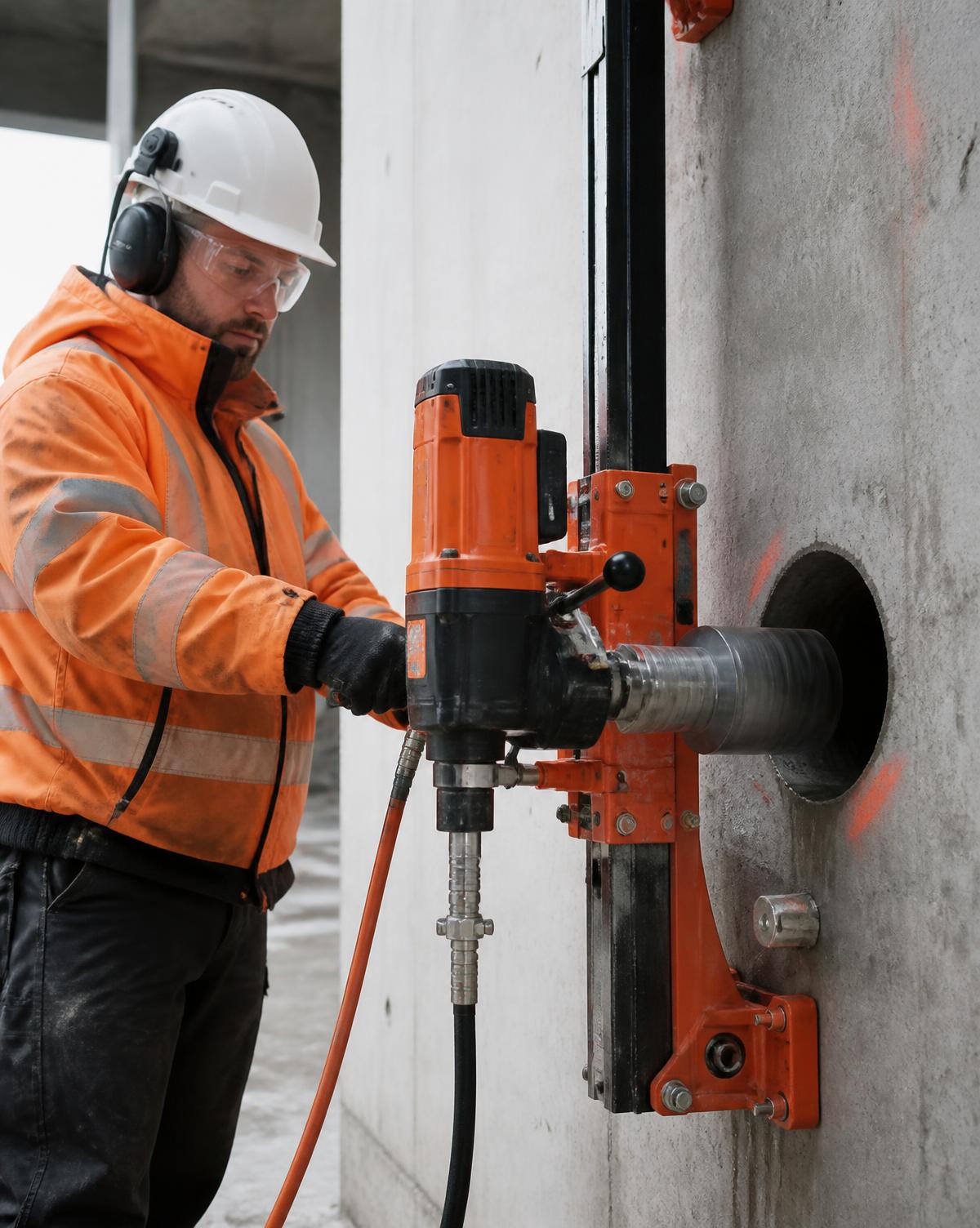
Diamond cutting involves noise, flying debris, water spray and fine dust, so PPE is non-negotiable regardless of job size. Our minimum kit for any cutting operation:
- Safety goggles or a full face shield for wall sawing
- Hearing protection, since handheld core drills and wall saws regularly exceed 85 dB
- Cut-resistant or heavy-duty gloves rated for wet handling
- Steel-toe boots with slip-resistant soles, especially important on wet-cut sites
- An N95 or P2-rated mask as backup even when wet cutting, since some dry cutting or grinding is unavoidable near edges
- High-visibility vest when working on active sites shared with other trades
Silica dust control
Concrete dust contains crystalline silica, and prolonged exposure without control measures is a recognised respiratory hazard. We treat wet cutting as the default method for any hole above 50 mm, since continuous water flow suppresses over 90 percent of airborne dust at the cutting point. Our full comparison of methods, including when dry cutting is unavoidable, is in wet cutting vs dry cutting and our dedicated piece on dust-free concrete cutting.
For occupied homes and offices, we also isolate the work area with plastic sheeting and run a wet vacuum for slurry collection so dust and debris do not spread into living spaces. The Central Pollution Control Board publishes broader guidance on construction dust management that informs how we plan larger jobs.
Electrical isolation
Before any core drilling or wall sawing, we check for embedded conduits and cabling using a cable/rebar detector, and where the exact routing is uncertain, we confirm with the building electrician or refer to as-built drawings. Water and electricity together are a serious combination, so on wet-cut jobs we always run equipment through an RCD (residual current device) protected socket, never a bare extension board.
Checklist before drilling near a wall
- 1Scan the area with a detector for rebar, conduit and pipe
- 2Confirm the power source is RCD protected
- 3Keep water hoses and cable runs separated and off the floor where possible
- 4Identify the nearest isolation switch in case of emergency
- 5Brief every crew member on the cut plan before starting
Structural awareness
Not every wall is a partition, and not every hole is harmless. Load-bearing walls, transfer beams and post-tensioned slabs need a structural engineer's sign-off before cutting, particularly in multi-storey buildings. We explain this process in structural approval for openings, and in Gurugram high-rise apartments this step is frequently mandated by the RWA or builder before work can even begin.
The riskiest job on our books is not the biggest cut, it is the one where nobody checked what was inside the wall first. We would rather delay a job by a day for a scan than explain a burst pipe or a cut cable afterwards.
Equipment inspection before every job
| Item | What we check |
|---|---|
| Diamond bit/blade | No visible cracks, segments not worn below safe minimum |
| Power cable | No exposed wire, plug intact, RCD tested |
| Water supply | Adequate pressure and flow, hose connections secure |
| Stand/rig anchoring | Vacuum seal or anchor bolts secure before drilling begins |
| Guarding | Blade guard fitted and functional on wall saws and floor saws |
Working around other trades and residents
On active sites we coordinate timing with other contractors so nobody is working directly below or beside a cutting operation, since falling cores and slurry runoff are real risks. In residential settings across Sector 56, DLF Phases and Golf Course Road, we also schedule cutting during hours agreed with the housing society to reduce disruption and confirm water drainage arrangements in advance so slurry does not run into common corridors.
- Cordon off the work area with barrier tape or cones
- Post a simple sign noting cutting is in progress and expected duration
- Keep bystanders, especially children, at a safe distance from the cutting radius
What to ask any cutting contractor about safety
If you are hiring a contractor, ask directly whether they carry PPE for the whole crew, whether they use a cable/rebar detector, and whether they will confirm structural approval for load-bearing cuts. A contractor who cannot answer these clearly is worth reconsidering, regardless of price quoted. You can review how we approach jobs on our about page or read through client project photos on the projects page.
Conclusion
Good safety practice on a cutting site is mostly about discipline, not equipment cost. PPE, dust control, electrical isolation, structural checks and equipment inspection, done every time, prevent almost all the incidents that happen on cutting jobs. If you want a crew that treats safety as standard practice rather than an afterthought, get in touch or call +91 9735 156 388.
Frequently asked questions
- Is wet cutting always safer than dry cutting?
- Wet cutting is safer for dust exposure and generally produces a cleaner cut, but it introduces electrical risk that must be managed with RCD protection and careful cable routing. Both methods are safe when done correctly with the right precautions.
- Do I need to leave my home during cutting work?
- Not usually for a single small hole with dust containment in place, but for larger wall saw or multiple-hole jobs we recommend keeping the immediate room clear, especially for children, elderly residents or anyone with respiratory sensitivity.
- How do you detect rebar and pipes before cutting?
- We use a handheld cable and rebar detector that reads through concrete to flag embedded metal and conduit runs, which we mark on the wall before drilling starts.
- What happens if a structural issue is found mid-job?
- We stop immediately, and if there is any doubt about load-bearing capacity, we pause and recommend a structural engineer's review before continuing, as covered in our guide on [structural approval](/blog/structural-approval-openings).
- Are safety standards for construction dust regulated in India?
- Yes, guidance exists from bodies like the [Central Pollution Control Board](https://cpcb.nic.in/) and the [Bureau of Indian Standards](https://www.bis.gov.in/), and we follow wet cutting and dust suppression practices consistent with this guidance.
- Do you provide safety documentation for corporate or society clients?
- We can share our standard safety checklist and method statement on request for RWA or facility management approval before starting apartment or commercial work.
Next step
Want a crew that treats safety seriously?
Ask us about our on-site safety checklist before you book your next cutting job.
Related guides
Methods
Dust-Free Concrete Cutting: How Wet Cutting Works Indoors
Wet diamond cutting controls silica dust at the blade edge, making it the practical way to cut concrete inside occupied homes and offices.
Safety
Structural Approval for New Openings: Who Signs Off
A practical guide to who actually needs to sign off on a new wall, slab or beam opening before you cut, and how to get that approval without delays.
Methods
Wet Cutting vs Dry Cutting: Choosing the Right Method
A clear comparison of wet and dry diamond cutting methods for concrete, including when each is the right choice for your job.